Judaism & Christianity: How the Bible Unites and Divides Them
Judaism and Christianity share much of the same sacred scripture, yet they interpret it in profoundly different ways. This shared Bible—often seen as a point of unity—is also one of the greatest challenges in Jewish-Christian relations.
At the heart of Judaism stands the Torah, the Five Books of Moses. More than a text, the Torah is the central symbol of Jewish life, representing divine revelation and God’s ongoing relationship with the Jewish people. Jewish worship reenacts this moment of revelation, emphasizing study, interpretation, and lived practice.
Christianity, which emerged from within Judaism, inherited these scriptures and read them through the life and teachings of Jesus. The New Testament—especially the Gospel of Matthew—draws deeply on Jewish tradition, presenting Jesus as a new Moses and retelling Israel’s story in a new theological key. Early Jewish listeners would have recognized these narratives immediately, even as they disagreed with their conclusions.
A key difference remains: Christianity depends on Jewish scripture to understand itself, while Judaism does not rely on the New Testament to understand its own faith or history. This asymmetry shapes how each tradition relates to the Bible—and to each other.
Understanding both the shared roots and the real differences between Judaism and Christianity is essential for meaningful interfaith dialogue, honest scholarship, and mutual respect.
Watch the video below, followed by the transcript.
Entire documentary available to rent on Amazon.
TRANSCRIPT:
The greatest obstacle in building relationships between Christians and Jews is what is also the greatest possibility. And that is the Bible. At least 75% of our Bible we have in common with the Jewish people, but we read it so differently.
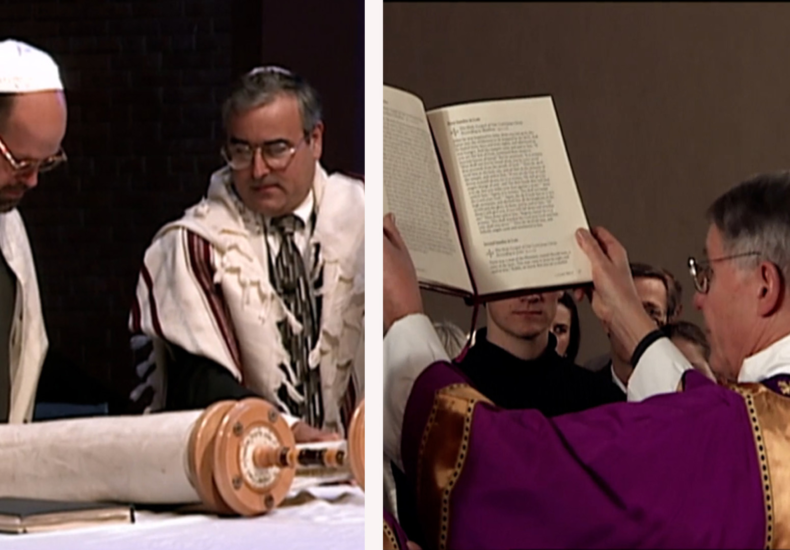
The central symbol for Jews is the Torah. That is the Torah, which is the in physically, it’s the scroll which contains the five books of Moses. Is the object which plays what you might call center stage. The Torah is read from, and it’s a combination of the content of the Torah and the symbol of what the Torah represents, which is the central symbol of Judaism. After all, the Torah was the object of revelation. According to the tradition, God gave the Torah through Moses to the Jewish people and through the Jewish people to the world, and the services, the principal services of Jewish observance always kind of reenact that drama.
The Torah is removed from the Ark in an act of pomp and circumstance, is a professional around the synagogue where the Torah is not so much worshiped, but it’s respected. It’s venerated.
In an overarching sense. Torah is God’s wisdom, and God’s will convey to the people is teaching. And this was the attitude of the first Christians, that the Torah was something valuable, something to be studied, something to be, applied, something to draw upon.
The essential narrative of the New Testament reflects teachings which are deeply rooted and reflected within the Jewish teaching of the time and the background from which Jesus came. The Holy Gospel of our Lord Jesus Christ, according to Matthew as David, plus the great scholar Israeli scholar who has written about Jesus, indicates, this narrative that we find within those texts is a totally Jewish narrative.
When Jesus grows up in the story of Matthew following the escape from Egypt, where does he go? He goes on top of a mountain and he delivers a law in Matthew that’s called the sermon on the Mount. But what would Jewish ears hear? Here are the children of Israel escaping Egypt. And where did they land? Mount Sinai and in case we missed those connections, Matthew makes it even stronger.
Jesus, when he grows up, is baptized. He goes under the waters of the river Jordan, and following that, he goes into the wilderness and experiences temptation. What have we from that? From the Jewish tradition. The Israelites leaving Egypt. Pass through the waters of the Red sea, and they go into the wilderness, and they experience temptation. For Matthew, Jesus is a new Moses, and he’s a new Israel.
He repeats the history of Israel, and any Christian, any Jew and Matthew’s community would hear those resonances, and the Jew would think, these are our stories told in a new key. But there are stories nevertheless.
The history of Judaism, the teachings of the prophets of Moses and and the story of Abraham, all of that already essential part of the Christian religion. Without it, without it, it wouldn’t be the Christian religion. However, the, the complementary is not true. Jews do not include the New Testament in their Bible.
Jews do not really, need the, the, the history of Christianity to understand their own history. They had thousands of years of history long before Christianity began,
You may also like