Judaism, Christianity, Islam: One God, Many Paths
Judaism, Christianity, and Islam are distinct religious traditions, yet they are deeply connected through monotheism—the belief in one God—and a shared moral vision rooted in the Abrahamic heritage. In an era marked by religious misunderstanding, fostering interfaith understanding begins with recognizing both the common ground and the real theological differences among these faiths.
All three traditions affirm that God has revealed divine guidance to humanity, though they understand revelation in different ways. Judaism and Islam locate the Word of God primarily in sacred scripture—the Torah and the Qur’an—while Christianity understands Jesus as the Word made flesh. These differing views shape how each faith community relates to God, authority, and history.
Despite theological disagreements over prophets, scripture, and revelation, Judaism, Christianity, and Islam share a powerful ethical core. Each tradition teaches that the one God is compassionate, moral, and actively engaged in human history, calling believers to justice, mercy, and responsibility toward others.
True interfaith understanding does not require minimizing differences. Instead, it depends on honest engagement with them—while recognizing that the shared commitment to monotheism and ethical living provides a strong foundation for dialogue, respect, and coexistence in a pluralistic world.
Watch the video below, followed by the transcript:
Entire documentary available to rent on Amazon.
TRANSCRIPT:
Jews, Christians, and Muslims have all developed remarkably similar notions of the divine. Even though they were often working in isolation from one another, and often in a state of deadly hostility with one another, Jewish, Christian and Muslim theologians have continually asked the same kind of questions about God.
There is more than just one way in which the power and grace of God can be experienced by humankind. It is not just mutually exclusive through the Christian experience that in fact, the claim that God had on Muhammad as a great prophet is, in my opinion, an equal claim that God had on His Son Jesus.
I would like the Jewish community in particular, to understand how close Islam as a religious way of life is to Judaism. How much Judaism and Islam share in common. And I would like, above all, for Jews to appreciate that Islam above all, refers to God as the all compassionate and is the most compassionate. And that compassion is a fundamental value within Islam.
As the Koran says very clearly that we have created human beings with different nationalities, different ethnic groups, different communities, so that they learn to know one another. The Arabic uses little Arab. That means they should know one another.
How can I sing my song to Jesus with abandon without telling dirty stories about others? That is the assignment for theologians in the 21st century.
Narrator:
This documentary compares similarities and differences in religious beliefs and practices that Islam has with Christianity and Judaism. Today, people of goodwill in the Abrahamic faith communities are coming to terms with historical conflicts that impact their lives today. They are dedicated to tearing down barriers to understanding and respect.
The opening prayer of the Koran being seen as really the Lord’s Prayer of Islam is something that if you shared that with a group of Christians in Middle America, they would probably fall over and need resuscitation, even money can only be. You know, I marvel when when people ask me a question about what they say, did you know that the opening prayer in the Koran is, is is sometimes referred to as the Lord’s Prayer of Islam? And my response is, so what? It is true. How did it get there? Common. Common heritage. Common linkages, and common pieces of respectful dialog and information sharing. Recognizing that we are connected, we do have a common source. There is one God.
What Jesus came to teach. What Moses came to teach is to love God. The whole idea of loving God with all of one’s heart and mind and soul and strength. I mean, when you look at this, this commandment to love the Lord your God with all of your heart and all of your mind, and all of your soul and all of your strength, I mean, this is not. This is a very profound statement because we are instructed to love the creator. Absolutely. If religion deals with the eternal in the human condition, its truths have to be universal, and they have to speak to the eternal in every human being.
The commonality is, in my mind, so overwhelmingly greater than that which separates the different communities, and that is rooted upon the recognition of the one God, creator of the universe.
A guide of history who is not only the one deity, but is a moral deity, and therefore a compassionate and gracious and loving deity who calls upon us to behave accordingly. That is the common theme that unites Islam, Christianity, and Judaism together, and it’s the overwhelming, overriding message of our common heritage.
I never like when people speak about the God of the Muslims and the God of the Jews, and the God of the Christians, as if they were different gods.
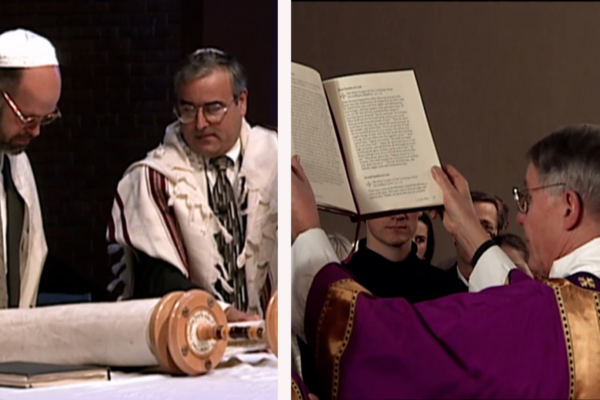
The Word of God is very important in all three of these faiths. In Judaism and Islam, the Word of God is in Scripture, in the Torah, or in the Koran. In Christianity, it’s Jesus who is the word that God has spoken to humanity.
The Koran is regarded by Muslims to be the Word of God. It is the Word of God in the same sense that Christians regard Jesus Christ to be the Word of God. And just as the soul of Jesus was implanted into the womb of Mary, a virgin. The Koran was planted in the heart of Muhammad.
Muslims affirm that there is a book, the Torah, that was given to Jews. There is the Evangelion, the New Testament that was given to Christians.
But the text that both Jews and Christians have today is not the exact text, and that therefore, where there are contradictions in any way between the Hebrew Bible and the New Testament with the Koran, it’s the Koran that is the correct text, and therefore the others are mistaken. And there are some very significant differences, mainly in the area of narrative rather than in terms of fundamental moral values.
In the Scripture, there’s an idea of chronology. The latest scripture is the Koran. Does that mean that, theologically speaking, the Koran abrogate or negates what the previous scriptures have taught? Now, the Koran does not support that idea because it says that each community has its own scripture, its own law, and it’s valid for them.
In essence, they are the same book because they convey the fundamental ethical, monotheistic vision of society and of human conduct. But as actual texts, the Koran is not the same book as the Hebrew Bible, and it’s not the same book as the New Testament, and therefore we are really peoples of the books rather than a people of the book.
You may also like